St Vincent's Code of Behaviour
Incorporating NCSE Relate and NCSE/Department Guidelines for Behaviours of Concern (2024)
1. Introduction & School Ethos
St Vincent’s School is a Catholic, co-educational primary school providing education for pupils with Moderate, Severe and Profound Intellectual Disability. Our aim is to work with parents/guardians to nurture the full and balanced development of every pupil. The self-esteem, safety, dignity and wellbeing of each member of our school community are central to our ethos.
In compliance with Section 23 of the Education (Welfare) Act 2000, the Board of Management has prepared this Code of Behaviour, which is informed by:
- NCSE Relate Model of Support (2023–2025)
- NCSE/Department of Education Guidelines on Understanding Behaviours of Concern and
Responding to Crisis Situations (2024)
- CPI (Crisis Prevention Institute) training
- Guidance from the Department of Education & Skills
This updated Code incorporates relational, regulation-focused, child-centred, and positive behaviour support approaches throughout.
2. Aims of the Code of Behaviour
General Aims
- To develop a whole-school positive behaviour framework rooted in relationships, respect and
shared values.
- To promote a safe, predictable, calm learning environment.
- To provide clarity on expectations, supports, and responses to behaviour.
- To align school practice with national guidance for supporting pupils with behaviours of concern.
Teacher Aims
- To enable teaching and learning without disruption.
- To use relational and positive behaviour approaches informed by NCSE Relate.
- To teach self-regulation, communication and social skills.
- To uphold pupil dignity and safety at all times.
Pupil Aims
- To develop self-esteem, self-regulation and independence.
- To understand and express needs safely and appropriately.
- To develop caring, respectful relationships with peers and staff
3. Guiding Frameworks
3.1 NCSE Relate Model
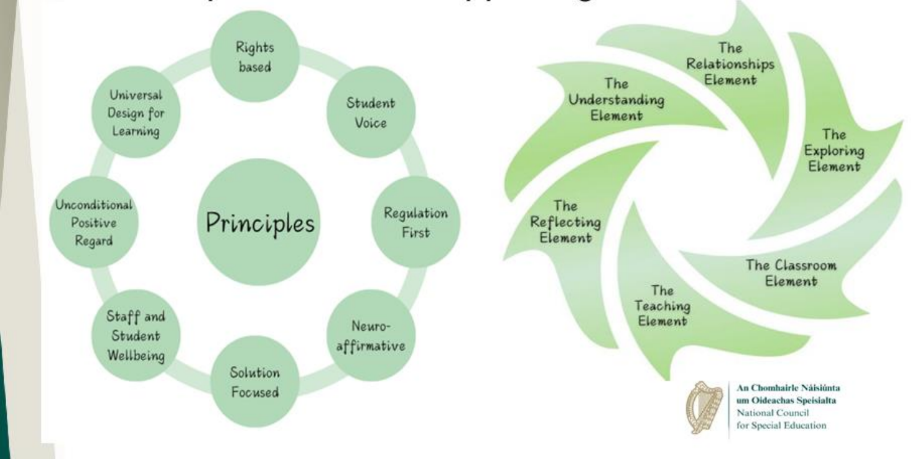
The school adopts the NCSE Relate model, which places high-quality, attuned relationships at the heart of behaviour support. Relate emphasises:
- A regulation-first approach
- A strengths-based, child-centred view of behaviour
- Eight relational principles
- Six elements of support (See Appendix 3)
- Tools such as Getting to Know Me and Solution-Focused Goal Setting
- Reflective practice
3.2 Guidelines on Behaviours of Concern (DoE/NCSE 2024)
- Behaviours of concern are expressions of need or distress.
- Prevention, early intervention and de-escalation must be prioritised.
- Physical intervention is a last resort and only when there is imminent risk of serious harm.
- Seclusion is not permitted.
- All incidents of restraint must be recorded and reviewed.
- From September 2025, all restraint incidents must be reported to the NCSE.
4. Promoting Positive Behaviour
Strategies include:
- Building strong relationships
- Relate principles such as curiosity, empathy and attunement
- Communication support (Coreboard, LÁMH, AAC)
- Predictable routines and visual supports
- Sensory and environmental supports
- Teaching social and regulation skills
- Reinforcing positive behaviour
- Collaboration with parents/guardians
5. Understanding Behaviours of Concern
Behaviours of concern are understood within the context of:
- Communication difficulties
- Sensory overload
- Pain or medical needs
- Trauma, anxiety or emotional distress
- Changes in routine or environment
- Developmental readiness
6. Individual Positive Behaviour Support Plans (PBSP's)
Developed with:
- Teachers and SNAs
- Parents/guardians
- MDT professionals
- NCSE/SENO support
PBSPs include:
- Likes & dislikes
- Medical Protocol
- known behaviours
- know stressers/triggers observed in last few years
- Preventative measures
- Deescalation/Diversion/Distraction
- Post Incident Support
7. Behaviour Management Framework
Preventative Approaches
- Reduce triggers
- Support regulation
- Low-arousal Strategies ( Appendix A)
- Sensory supports
Early Intervention
- Reduce demands
- Offer breaks
- Calm communication
- Sensory strategies
Crisis Response
- CPI (Crisis Prevention Institute) least-restrictive interventions only when required for safety
- Continuous supervision
- No seclusion
8. Protocols for Behaviour
Low-Level Protocol
1. Define behaviour
2. Track behaviours
3. Assess environment
4. Adjust environment
5. Apply PBSP strategies
6. Seek Management support
7. Update PBSP
8. MDT/NCSE consultation
High-Level Protocol
1. Risk assessment
2. Low-arousal techniques
3. Follow low-level steps
4. CPI physical intervention if required
5. Notify principal
6. Debrief
7. Notify parents
8. Document incident
9. Update PBSP
10. Reflective practice
9. Incident Reporting
- All significant incidents are recorded and stored securely.
- Behaviour data informs planning and risk reduction.
- All restraint incidents reviewed.
- From Sept 2025, restraint reporting to NCSE.
10. Suspension & Expulsion
Before serious sanctions such as suspension or expulsion are used, the normal channels of communication between school and parents will be utilised. Communication with parents may be verbal or by letter depending on the circumstances.
For gross misbehaviour or repeated instances of serious misbehaviour suspension may be considered. Parents concerned will be invited to come to the school to discuss their child’s case. Aggressive, threatening or violent behaviour towards a teacher or pupil will be regarded as serious or gross misbehaviour.
Where there are repeated instances of serious misbehaviour, the Chairperson of the Board of Management will be informed and the parents will be requested in writing to attend at the school to meet the Board and the Principal. Parent support is envisaged around positive behavioural
changes. In the absence of this support the Board would have a number of sanctions open to them, up to and including expulsion. Prior to suspension, where possible, the Principal may review the case in consultation with teachers and other members of the school community involved, with due
regard to records of previous misbehaviours, their pattern and context, sanctions and other interventions used and their outcomes and any relevant medical information. Suspension will be in accordance with the Rules for National Schools and the Education Welfare Act 2000.
In the case of gross misbehaviour, where it is necessary to ensure that order and discipline are maintained and to secure the safety of the pupils, the Board may authorise the Chairperson or Principal to sanction an immediate suspension for a period not exceeding three school days, pending a discussion of the matter with the parents.
Expulsion may be considered in an extreme case, in accordance with the Rule for National Schools and the Education Welfare Act 2000. Before suspending or expelling a pupil, the Board shall notify the Local Welfare Education Officer in writing in accordance with Section 24 of the Education Welfare Act.
Please See Appendix B for formal Procedures for Suspension & Expulsion.
11. Roles and Responsibilities
Board: ensure safety, support policy, ratify.
Principal: lead positive school culture, ensure implementation.
Teachers/SNAs: relational approaches, follow PBSPs, record incidents.
Parents: support strategies, collaborate on PBSPs, communicating on SEESAW
12. Review and Ratification
The policy will be reviewed annually or sooner if necessary.
Ratified by Board of Management on
Reviewed by staff on the 24/11/25
Reviewed by BOM on 25/11/25
 Section to be Signed by Parent/Guardian:

I have read the above Code of Behaviour document and agree to abide by it.
Parent/Guardian: _________________________________ Date:___________
Parent/Guardian: _________________________________ Date: ___________
Appedix A: Low Arousal Strategy
- Appear CalmStaying calm – in both voice and body language. Demonstrate positive body language by not looking tense – e.g. arms folded/ waving and breathing slowly. Speaking softly, slowing down, keeping instruction short
- Personal SpaceMaintain a safe distance (one metre or so) while ensuring the pupil’s safety, keep near an exit
- Eye Contact
Do not stare at the individual, maintain conversational eye contact. Giving intermittent eye contact to help reassure. - Touch
Avoid touching the individual even if you are very familiar with them, as it may not be interpreted by the individual in the manner you intend. Avoiding touching pupil until they have regained control. - Noise
Surrounding noise can be upsetting to an individual, turn off noise and remove any unnecessary environmental sounds. Removing unnecessary demands or requests. - Listen
Listen to what the individual is communicating, sit or kneel while maintaining a safe distance. Making it clear that the child is being listened to. Helping the pupil to identify and express their upset and needs. Staying at their level. - Distract
Try to distract/redirect or engage the individual in a chat or activity that they like in a discreet manner. Offer a preferred object/activity now/later and ensure it is followed through. Allow the child time to recover from Incident before moving on. - Remove other people
It can be easier to remove other people from a situation as opposed to the individual who is upset.
Appendix B: Procedures for Suspensions & Expulsions
(As recommended by St. Senan's Diocesan Office)
Suspension
Definition of Suspension:'requiring the student to absent himself/herself from the school for a specified, limited period of school days'
Developing A Code of Behaviour: Guidelines for Schools, National Educational Welfare Board
Authority to Suspend:
The Board of Management of St. Vincent’s School has formally and in writing delegated the authority to impose an ‘Immediate Suspension’ to the Principal Teacher. An ‘Immediate Suspension’ may be for a period of one to three school days depending on the severity of the specific Behaviour, in exceptional circumstances and with the approval of the Chairperson of the
Board the suspension may be for a longer period but in any event will not exceed 5 school days.
Furthermore, the Board of Management has formally and in writing delegated to the Principal Teacher the authority to impose an ‘Automatic Suspension’ for named behaviours detailed in this policy. An Automatic Suspension may be for a period of one to three school days depending on
the severity of the specific behaviour, in exceptional circumstances and with the approval of the Chairperson of the Board the suspension may be for a longer period but in any event will not exceed 5 school days.
The Board retains its authority to suspend a student in all other cases/circumstances.
Immediate Suspension and Automatic Suspension
An ‘Immediate Suspension’ will be deemed to be necessary where after a preliminary investigation the Principal reaches the determination that the continued presence of the pupil in the school at the time would represent a serious threat to the safety and wellbeing of pupils or staff of the school. An ‘Immediate Suspension’ may be for a period of one to three school days
depending on the severity of the specific Behaviour, in exceptional circumstances and with the approval of the Chairperson of the Board the suspension may be for a longer period but in any event will not exceed 5 school days.
An ‘Automatic Suspension’ is a suspension imposed for named behaviours. The Board of Management of St. Vincent’s School, having given due consideration to its duty of care as prescribed by Health & Safety Legislation, has determined that the following named behaviours
will incur ‘Automatic Suspension’ as a sanction;
• Physical assault/violence resulting in bodily harm to a pupil or member of staff
or
• Physical violence resulting in serious damage to school property
or
• Leaving the school without permission during the school day.
An Automatic Suspension may be for a period of one to three school days depending on the severity of the specific Behaviour, in exceptional circumstances and with the approval of the Chairperson of the Board the suspension may be for a longer period but in any event will not exceed 5 school days.
Parent(s)/Guardian(s) will be informed of an Immediate or Automatic Suspension by telephone, and arrangements will be made with them for the pupil to be collected. In no circumstance will a student be sent home from school prior to his/her parent(s)/guardian(s) being notified. Formal
written notification of the suspension will issue in due course, but no later than 2 school days after the imposition of the suspension. Such a notification will detail:
• the duration of the suspension and the dates on which the suspension will begin and end
• the reasons for the suspension
• any study programme to be followed
• the arrangements for returning to school, including any commitments to be entered into by the pupil and the parent(s)/guardian(s).
The Board of Management acknowledges that the decision to impose either an Immediate or Automatic Suspension does not remove the duty to follow due process and fair procedures. In this regard, and following a formal investigation, to be completed no later than 2 school days after the
incident the Board will invite the pupil and his/her parent(s)/guardian(s) to a meeting to discuss;
• the circumstances surrounding the suspension
• interventions to prevent a reoccurrence of such misconduct.
The Board of Management of St. Vincent’s School acknowledges the fundamental importance of impartiality in the investigation process. In this regard the following undertaking is given;
i. No person with a vested interest or personal involvement in the matter will be involved in the organisation or implementation of the investigation procedure.
Procedure in Respect of Other Suspensions:
In cases other than those of Immediate or Automatic Suspension the following procedures will apply;
Where a preliminary assessment of the fact confirms serious misbehaviour that could warrant suspension, the Board of Management of St. Vincent’s School will initiate a formal investigation of the matter. The following procedures will be observed;
A written letter containing the following information will issue to Parent(s)/guardian(s);
i. details of the alleged misbehaviour, details of the impending investigation process, and
notification that the allegation could result in suspension.
ii. An invitation to a meeting, to be scheduled no later than 5 school days from the date of the letter, where parent(s)/guardian(s) are provided with an opportunity to respond before a decision is made or a sanction imposed. The Board of Management of St. Vincent’s School acknowledges the fundamental importance of impartiality in the investigation and decision-making process. In this regard the following undertakings are given;
ii. No person with a vested interest or personal involvement in the matter will be involved in the organisation or implementation of the investigation procedure, nor will such a person be involved in the decision-making process.
iii. The person(s) involved in the investigation process will on presentation of a full report of the facts absent himself/herself/themselves from the decision-making process. Where a decision to suspend has been made the Chairperson of the Board of Management will provide written notification to the parent(s)/guardian(s) and the pupil of the decision. The letter
will confirm:
• the duration of the suspension and the dates on which the suspension will begin and end
• the reasons for the suspension
• any study programme to be followed
• the arrangements for returning to school, including any commitments to be entered into
by the pupil and the parent(s)/guardian(s)
• the provision for an appeal to the Board of Management.
Where a suspension brings the total number of days for which the pupil has been suspended in the current school year to twenty days the parent(s)/guardian(s) will be informed of their right to appeal to the Secretary General of the Department of Education and Skills under Section 29 or the Education Act 1998 and will be provide with information on the submission of such an appeal.
Expulsion
Definition of Expulsion:
‘A student is expelled from a school when a Board of Management makes a decision to permanently exclude him or her from the school, having complied with the provisions of section 24 of the Education (Welfare) Act 2000.’
Authority to Expel:
The authority to expel a pupil is reserved by the Board of Management.
Procedures in Respect of Expulsion:
Where a preliminary assessment of the facts confirms serious misbehaviour that could warrant expulsion the following procedures will apply:
a) A detailed investigation will be carried out under the direction of the Principal (or a Nominee of the Board if required) As part of the investigation a written letter containing the following information will issue to parent(s)/guardian(s);
iii. details of the alleged misbehaviour, details of the impending investigation process, and notification that the allegation could result in expulsion.
iv. An invitation to a meeting, to be scheduled no later than 5 school days from the date of the letter, where parent(s)/guardian(s) are provided with an opportunity to respond.
b) The Principal (or BoM Nominee) will make a recommendation to the Board of Management
Where the Principal (or nominee) forms a view, based on the investigation of the alleged misbehaviour, that expulsion may be warranted, the Principal (or nominee) makes a recommendation to the Board of Management to consider expulsion. In this event the Principal (or nominee) will:
i. inform the parent(s)/guardian(s) that the Board of Management is being asked to consider expulsion
ii. ensure that parent(s)/guardians have records of: the allegations against the student; the investigation; and written notice of the grounds on which the Board of Management is being asked to consider expulsion
iii. provide the Board of Management with the same comprehensive records as are given to parent(s)/guardian(s)
c) Consideration by the Board of Management of the Principal’s (or BOM’s Nominee) Recommendations & the Holding of a Hearing
If, having considered the Principal’s report, the Board of Management decides to consider expelling a student a hearing will be scheduled.
The parent(s)/guardian(s) will be notified in writing
i. as to the date, location and time of the hearing
ii. of their right to make a written and oral submission to the Board of Management
iii. that they may if they so choose be accompanied at the hearing
The Board of Management undertakes that the timing of such written notification will ensure that parent(s)/guardian(s) have enough notice to allow them to prepare for the hearing.
In respect of the expulsion hearing the Board gives an undertaking that;
i. the meeting will be properly conducted in accordance with Board procedures
ii. the principal (or BoM nominee) and parent(s)/guardian(s) will present their case to the Board in each other’s presence
iii. each party will be given the opportunity to directly question the evidence of the other party
iv. the parent(s)/guardian(s) may make a case for a lesser sanction if they so choose
(d) Board of Management Deliberations & Actions following the Hearing
Where the Board of Management, having considered all the facts of the case, is of the opinion that the pupil should be expelled the Board
i. Will notify the Educational Welfare Officer in writing by registered post of its opinion, and the reasons for this opinion.
ii. Will not expel the student before the passage of 20 school days from the date on which the Educational Welfare Officer receives this written notification.
iii. Will in writing notify the parent(s)/guardian(s) of their decision and inform them that the Educational Welfare Officer is being contacted
iv. Will be represented at the consultation to be organized by the Educational Welfare Officer
v. Will suspend the student, if it is deemed likely that the continued presence of the student during this time will seriously disrupt the learning of others, or represent a threat to the safety of other pupils or staff.
e) Confirmation of the Decision to Expel
Where the twenty-day period following notification to the Educational Welfare Officer has elapsed, and where the Board of Management remains of the view that the student should be expelled, the Board of Management will formally confirm the decision to expel.
Parent(s)/guardian(s) will be notified in writing that the expulsion will now proceed. They will also be informed of their right to appeal to the Secretary General of the Department of Education and Skills under Section 29 or the Education Act 1998 and will be provide with information on the submission of such an appeal.
The Board of Management of St. Vincent’s School acknowledges the fundamental importance of impartiality in the investigation and decision-making process. In this regard the following undertakings are given;
i. No person with a vested interest or personal involvement in the matter will be involved in the organisation or implementation of the investigation procedure, nor will such a person be involved in the decision-making process.
ii. The person(s) involved in the investigation process will on presentation of a full report of the facts absent himself/herself/themselves from the decision-making process.
Appendix 3: Relate Principals and Elements